Manchester, UK, 12 August 2026 – An estimated 90,000 jobs are forecast to relocate from London to regional centres across the UK by 2031, according to new analysis from global talent solutions partner Robert Walters. This onshoring activity could generate up to £9bn for regional economies across the UK.
Once relocations are complete, the initial £9bn generated as of 2031 is expected to rise between £12-15bn per year with increased local supply-chain demands and consumer-spending activity.
Onshoring is the practice of relocating business processes or functions away from higher-cost or highly saturated regions, like London and the South East, to other parts of the country.
Jonny Bohane, Senior Manager – Market Intelligence at Robert Walters: “Our forecast indicates a rebalancing of the scales towards stronger regional jobs growth over a widespread shift of business activity away from London.
“The projection is a result of growing economic momentum seen across the rest of the UK, led by high performing regions like the North West, Midlands, and Yorkshire. Alongside the UK government’s focus on stimulating regional growth and creating a more balanced national economy.”
Indeed, the new forecast by the Robert Walters Market Intelligence team aligns with the UK Prime Minister Andy Burnham’s plans for wider political devolution and regional economic growth, which have already seen the launch of a Northern branch of Downing Street, No 10 North.
Despite this, the UK remains one of the most fiscally and politically centralised nations in the OECD, with London generating one in every four pounds nationwide. The predicted total of jobs leaving the capital in the forecast represents approximately 2.5% of its overall workforce over the next five years.
Daniel Harris, Managing Director – UK&I at Robert Walters: “Onshoring talent strategies are becoming more popular among UK business leaders, as they decide how to map workforces closer to home in the wake of continuing global macro-economic disruption. While many firms are keeping their senior leadership teams headquartered in the capital, over the past 12 months we’ve noticed an uptick in businesses requesting support in setting up operations or shared service centres across the UK regions.”
Regional Expansion of Jobs
The forecast for regional job movement is expected to build gradually over the next five years, as corporate expansions and government relocation programmes mature. By 2027, around 8,000-12,000 jobs are predicted to move out of the capital, rising to 30,000-45,000 by 2029.
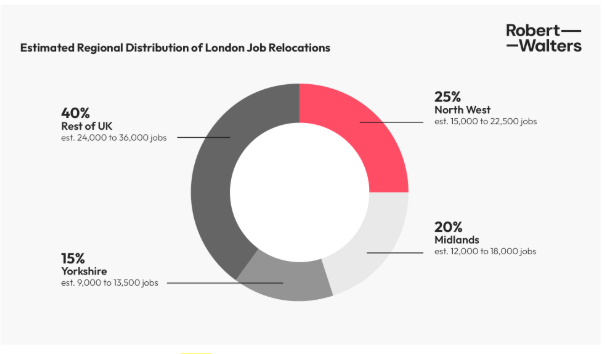
The North West will be a major beneficiary of this shift, with approximately 15,000–22,500 jobs predicted to relocate there over the next five years, accounting for one-quarter (25%) of total movements out of London. This could inject up to £2.25bn into the region’s economy by 2031, reinforcing its status as the UK’s second hub for growth and innovation.
The Midlands could claim a fifth (20%) of the relocated positions, representing between 12,000 to 18,000 new jobs entering the region over the next five years, which could generate £1.8bn for the local economy.
Meanwhile Yorkshire stands to command a 15% share of the newly regionalised positions, accounting for 9,000 – 13,500 local jobs and boosting its economy by £1.35bn over the next five years.
Daniel continues, “Manchester, Leeds and Birmingham are the engine rooms of activity. Over the last decade, these regional centres have become key career destinations for UK white-collar workers. They offer a significant presence of high-profile, multinational employers, vibrant cultural scenes and leisure opportunities, as well as a lower cost of living compared to the capital.
“Birmingham is home to Deloitte’s biggest practice outside of London, the industrial automation giant Siemens recently relocated its UK headquarters to Manchester, and the Bank of England plans to have approximately 1 in 10 of its staff working out of Leeds by 2027.”
Of the remainder of total London job movements (40%), approximately 24,000–36,000 jobs are set to relocate to other regional centres including Bristol, Edinburgh, Glasgow, Cambridge, Newcastle, Liverpool, Reading, and Cardiff. This accumulates in a combined economic gain of up to £3.6bn.
“The appeal of these regional cities shouldn’t be underestimated. But growth isn’t determined by businesses relocating or creating new jobs alone,” adds Jonny. “When professionals move into an area, the benefits ripple through the local economy. Increased demand supports everything from transport and housing to cafés, co-working spaces and the wider network of local businesses that keep these cities running.”
The predictive data forms part of the global talent partner’s newly released Onshoring Guide, which investigates how onshoring activity and regional hiring plans across engineering, finance, or business support functions are increasing across the UK.
“As more businesses recognise the unique strengths of the UK’s regional centres, cost considerations remain high, and hybrid working allows organisations to build more geographically diverse teams, we’ll continue to see both existing and new business operations expand their national footprints.
“This shift won’t happen in isolation, and will require collaboration between employers, specialist recruiters, local authorities, infrastructure providers and supply chains to ensure regions can support growing demand and help businesses fill the new roles over the next five years,” concludes Daniel.